
Prime Focus has a new tool for converting 2-D to 3-D more quickly and efficiently, and Mike Fink tells us all about it.

Earlier this month, Prime Focus hosted a series of receptions touting its new global rebranding, including the launch of View-D, a proprietary 2-D-to-3-D conversion process that allows filmmakers to efficiently create stereoscopic 3-D movies from source material shot on virtually any medium. Mike Fink, CEO of Prime Focus VFX, recently chatted about its benefits for converting both library titles and new releases.
Bill Desowitz: How did this come together?
Mike Fink: The short story is that we knew that there were people out there trying this and we have worked the last couple of years on a few stereo movies. And sometimes we had to fix things, and we developed some ways to salvage an eye and make it work. Anyway, Chris Bond was looking at stereo and we were approached by a couple of studios if we had a technique for converting 2-D to 3-D, and were we interested in showing them anything. Well, we didn't have a technique at the time, but we talked about it and came up with things to think about. And one day, Chris said to himself: "I think I know how to do this." So he sat down at his computer, and really had a proof-of-concept within 45 minutes. We already had people in India working on something that was not too dissimilar from what Chris was working on: typical of India because they have such an abundance of people to do this work. But there's was much more labor intensive and similar to what's being done elsewhere -- and probably would've gotten us into patent issues. But Chris' technique was really different, really new. And really looked at 2-D and 3-D in a different way and got a good-looking result.
BD: What happened next?
MF:
We started developing the code for other purposes and re-purposed it for this. But then we started cleaning it up and making it non-specific.
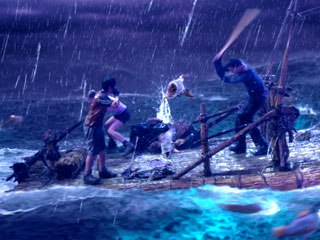
BD: Did this come out of Journey to the Center of the Earth?
MF: Some of it came out of Journey; some of it came out of a recent stereo movie that we're working on now. All from experiences we've had working on compositing stereo images. But we have an R&D department in Winnipeg doing lots of plug-ins and codes for all kinds of things to images to improve the composite. And it turns out that some of those tools, when applied correctly, can do some amazing things to create a second eye. And they had to be applied in the right order and they had to be tweaked and there was a lot of work that needed to be done, but in the end we had a process which converts 2-D to 3-D and gives you a great-looking image.
BD: Rob Hummel [CEO of the rebranded Prime Focus Post Production] was said he was impressed.
MF: He hadn't even signed his contract yet -- we had him sign an NDA -- when we showed him our very first test for our first client. And he was blown away and he's a stereographer. And we told him we weren't quite done. So we continued to work on the software and applied for 18 patents.
BD: So what's the secret sauce?
MF: Well, I can't tell you now, can I?
BD: What can you tell me?
MF: Basically, what Chris realized was that a lot of what he was watching was a trick and that, in fact, it wasn't the proper stereo image at all. But it looked pretty good. And he thought he could do better. So he took it further but didn't use the same technique at all. And what's amazing is that that the test footage [turned out as good as it did]. It was very difficult to get any three-dimensionality, even though it had good perspective. Everything about it -- the guy was the same density in color as the background, there was no motion blur, there was no atmosphere -- all those things that really help make an image look 3-D, even if it isn't very good 3-D, weren't there. So we knew if we could get our system to work on that footage, we could just about crank out anything. And that material took about twice as long to process as a normal feature film that had been shot as a dramatic narrative, and not as a film emulsion test. We had to dig more information out of the image.
BD: Then let's talk more about how the system works interactively like a DI session.
MF:
We designed the pipeline so that at a particular step in the process the director or the studio supervisor or stereographer or whoever is put in charge of doing this conversion can come by and work with us -- pretty much like a DI -- and set the convergence and set the image so that the stereo looks proper to them: set some key scenes through the movie. And then we go do our work, and then they come back again, and then we do it again. So there is a feedback loop almost as quick as DI. It's not as fast as a DI because it's more complex. But it's going to render pretty quickly.
BD: So it's the precision and interactivity of the conversion that is really new?
MF: The great advantage of this tool over shooting with two eyes is there are lots of difficulties [shooting in stereo]: just technical issues of one camera being softer than the other, one camera not being perfectly aligned to the other. And, of course, nowadays, the big issue if you want to shoot in stereo all the rigs are digital cameras. Nobody's shooting film stereo movies because they're big and they're clunky and they're difficult to deal with. The good thing about a process that converts from 2-D to 3-D is that you can shoot on film because you don't have to shoot with two cameras and there are a lot of cinematographers who are real happy about that. And there are issues with a digital image that is captured: there's some processing that has to happen to the image to make it look better, especially doing a stereo movie and especially when you get into things like how flares react with the chip. So there are technical things nobody really talks about in the business, but are part of shooting a stereo movie. And really nobody talks about them because most of the 3-D work that has any profile at all, like Journey or Avatar, the directors were Eric Brevig and Jim Cameron. And these guys know what they're doing: they're smart and technically savvy. Believe me: I'm not trashing the idea of shooting in stereo or with two cameras: it's one of the tools in the arsenal of filmmaking. And we have another one: and ours is you can shoot with one camera and you can shoot on film or you can shoot digitally or with your iPhone -- and we'll convert it for you.
Bill Desowitz is senior editor of AWN & VFXWorld.

Bill Desowitz, former editor of VFXWorld, is currently the Crafts Editor of IndieWire.