
The former Blue Sky and Pixar vet tells us what it's like making the transition to directing live action.
Check out the Jonah Hex trailer and clips at AWNtv!

Jimmy Hayward definitely has a dark side, taking on Jonah Hex as his first live-action feature after a successful career in animation at Pixar and then Blue Sky. Hex is a far cry from Horton Hears a Who!. But apparently this DC comic adaptation about a scarred ex-Confederate-turned vengeful bounty hunter (Josh Brolin) is not such a stretch.
Bill Desowitz: How much of a departure is Jonah Hex?
Jimmy Hayward: It's a departure only because I've been doing big four-quadrant family movies for so long. I enjoyed making Horton because it was material that I really liked. But this material is really dear to me that I've been into since I was a kid. So in that respect, it wasn't a departure. In fact, when I went into my first meeting with Warner Bros., I had a weird Western tale digest with me that I've had since I was eight or 10-years-old.
BD: What was your take on this?
JH: My take was that Westerns today are made in the somewhat traditional sense. Obviously, movies like 3:10 to Yuma I love. So why not take Jonah Hex -- who is an action figure -- and make an action film. We'll blow up trains, but in terms of the way we shoot it and cut it, the music we put to it, we'll bring it into a new age. And I think my choice to use Mastodon, the progressive heavy metal band, and to push it into new territory with the timing of the action and with the DNA of the movie. We take it for granted the way the spaghetti Westerns used music, with Morricone and the twangy guitar, but the way they shot and cut them with the music was an alien thing back then. And I think it was trying to push [the Western] into a new direction like that and get operatic by the end of this movie where we're in this revenge fantasy in his mind.
BD: What about the videogame influence?
JH: I think it's impossible not to be influenced by videogames given that I'm such a gamer and I'm in the generation of videogames that grew up all around us. I don't know how it comes out in the movie. Maybe you can tell me.

BD: The way the action unfolds is similar to a videogame. Of course, you also have his stylized inner thoughts as well.
JH: Well, one of the things that we found out when we were cutting the movie was that once you found out that Quentin Turnbull [John Malkovich] was alive, it was a non-stop, Terminator-style 'til he gets him kind of thing. And we found if we took side journeys that it took away from that. And the length of the movie has to do with that because we cut it down shorter.
BD: Eighty minutes is pretty short these days.
JH: A graphic novel is more like what it is. The essential idea was to get him where he needs to go.
BD: How was your animation background helpful to you?
JH: I think anything that has to do with illustration and visual storytelling. Except for the scenes when he stops and has moments with Jeffrey Dean Morgan [who plays the buddy he killed] or Tom Wopat [as Col. Slocum], he doesn't say a lot. So there's a lot of visual storytelling. When you look at the train sequence or when he rides into town at the beginning of the movie, it's all composing the frame and shot flow. When you project it, it all winds up flat -- whether it's animation or live action. Preparing the movie and making the movie, it's a major difference.

BD: Did you previs?
JH: Oh, yeah, I storyboarded and did animatics. I think because of my history in animation doing a lot of pre-planning and pre-cutting of stuff, I was able to better handle all of the action sequences. I drew everything out and cut it all together. And all the vfx sequences, of course, we planned out that way. We did a little bit of previs with the boat attack on the capital. But, for the most part, it was storyboards and animatics and cutting everything into the Avid.
BD: What was the role of vfx?
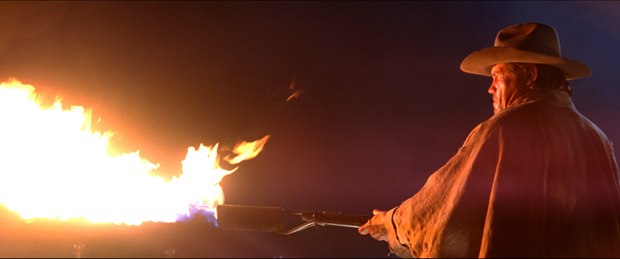
JH: We set out to do as much practically as we could. So the explosion in the town at the beginning and the explosion on the train are practical and one explosion on the boat is practical. There is no CG enhancement on those at all. And the rest of it is environments in Washington with set extensions, a CG dog running around. Then, of course, the skies in the red clay sequences in his revenge fantasies are all vfx; the Indian village [with CG smoke and CG crows]; and whenever the boat is in the water; sky replacements; the Washington attack stuff; all those cannonballs ripping through Washington; the explosion in the town; blowing up Will Arnett's boat.
BD: What was the hardest part directing this?
JH: It's funny: Andrew Adamson said, "Just make sure you get everything." The trick is, with animation, you can always go back. So I think the hardest difference is that, in the execution, you have to make decisions a lot faster and on the fly and under a great deal more pressure. And in that respect, we had a great group of people to work with and it was a massive learning experience for me -- I have a whole new set of tools to work with.
BD: How difficult was it avoiding an R?
JH: It was tricky -- there was more violence; there's a missing love scene between Megan and Josh. God knows, we had a lot more of Megan, and she was very cool about it -- nothing tasteless. It's a lot more graphic but just not bloody. But when he puts [that head] through the propeller, we actually have a much graphic version where it actually chops off the back of his head. So there were deleted scenes.
BD: Will they wind up on the Blu-ray/DVD?
JH: I think we'll definitely have some great deleted scenes for the DVD. I actually like the fact that it's PG-13 because it doesn't become exploitive. I'd rather look at Malkovich's eyes when he's executing somebody than a bunch of blood splatter out of an exit wound. One tells the story of a character and the other's just guts.
BD: Have you seen Toy Story 3 yet?
JH: I was just staying with Jason Deamer and am still friends with all those guys at Pixar, but I haven't seen it yet. It's ironic, being involved with Pixar all those years and working on Toy Story and Toy Story 2, that it's opening on the same day as Toy Story 3. Talk about getting killed!
Bill Desowitz is senior editor of AWN & VFXWorld.

Bill Desowitz, former editor of VFXWorld, is currently the Crafts Editor of IndieWire.