
Christian DeVita and Mark Gustafson go deeper into storyboarding and animating Wes Anderson's Fantastic Mr. Fox.

Working with Wes Anderson is always an adventure and perhaps never more so than on his first stop-motion feature, Fantastic Mr. Fox(opening today from Fox Searchlight). As one filmmaker puts it, "His fascination with the fine detail of clothing is fascinating -- the correct position of a button hole in an animated character's jacket, his interest in keeping the 'imperfections' of traditional stop-motion, his lack of interest in polished finish."
Indeed, for Roald Dahl's Fox, Anderson insisted on fur and shooting on 2s: two no-nos for stop-motion. But the unconventional director wasn't about to approach stop-motion in any conventional way, inspired by Le Roman De Renard (The Tale of the Fox) by Ladislas Starevich as well as the films of Willis O'Brien and Ray Harryhausen.
So what was it like for two other newcomers to the world of stop motion feature animation: Christian DeVita, the lead story artist, and Mark Gustafson, the animation director? DeVita (Chop Socky Chooks, Gordon the Garden Gnome, Space Jam) has his own company in London, One Hand Clapping, but was hold up with Anderson in Paris for more than a year while production took place at Three Mills in East London. Meanwhile, Gustafson (Ananda, The PJs) had to accommodate both an unorthodox working procedure and working remotely with Anderson.
"I was brought in the project early on," suggests DeVita. "After the first pass of sketches, Wes asked me to work with him closely in Paris. My responsibility was to produce the animatic with two members of the editorial team. Initially, we thought we'd be there for a month or so and that escalated to more than a year. There were several versions of the animatic: scenes got cut while others never made it into the movie. We were working right through the last week of animation and I was producing boards that potentially could be in the movie. The animatics were a great way for us to try so many different versions and just get it right.
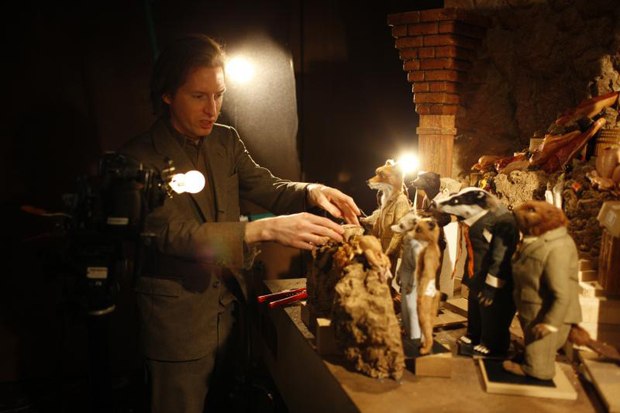
"Wes was very much hands on in every aspect from design right on through the type of stitching on the clothing and texture on the wallpaper as well as how characters would move and act. He performed every character in front of a free camera and we'd put together [something] for all of the animators to follow. Even though he wasn't on set, it was like he was on every single set [remotely]."

DeVita fondly recalls seeing the puppets for the time when sitting in his Paris hotel. "Mackinnon & Saunders brought in Fox, Mrs. Fox and Bean. They were great, great puppets -- very natural and very detailed, and detailed in the way the armatures worked. The interesting thing is that Wes approached animation in a very unique way. It looks, feels and moves very differently, including the limited use of f-stops. In animation, I've never come across that before. The first month, I was trying to get used to drawing characters in sets the way Wes wants with limited camera movement, characters talking to the camera and reversing shots with another character talking to the camera. In that respect for me it was a very difficult challenge. Wes pretty much thumbnailed a good part of the movie. We were literally sent stamp-size drawings from Wes on stick notes, notepads from hotel rooms and some napkins from a restaurant, and they were all collated for us. Eventually, when I was working in Paris, he'd show me a stickman shape or a position. And we'd go from there…
"I was quite amazed at the type of story that Wes was able to create out of such a thin book. This is my first stop-motion film. I come from a traditional 2D background and worked on CG projects. I had storyboarded for stop-motion TV series, but that just entailed blocking positions. The amount of panels for each shot and poses was way more extensive on this. I hope he doesn't leave animation. I'll be interested to see if he enjoyed the experience and is interested in making more of these."
As for Gustafson, this was nothing like the stop-motion TV work he had done for Will Vinton, so there were a lot of adjustments as well as some initial frustration, which has received a lot of attention in the Los Angeles Times.
"Once we decided we were going to shoot with puppets that had fur -- unless we were going to take five years to shoot it-- there was a certain aesthetic we decided to embrace," Gustafson offers. "Wes was really focused more on the story and the characters and a certain kind of design sense to the whole film that didn't involve really polishing all of the animation to within an inch of its life. That's something you have to [accept] and you have to make the best version of this that you can. I think ultimately when you see it as a piece that it holds together -- it has its own language and is absolutely true.
"It was an interesting process because we were dealing with a filmmaker in Wes Anderson, who didn't have a lot of experience in this and his idea was to make a Wes Anderson film, as well it should be. So we had to come to him with our process. Obviously he made certain compromises as well but we tried as hard as we could to ultimately give him the film he wanted to make.
It's all about detail, which Anderson was preoccupied with, and we could indulge that. He's very good at creating a seamless world that reflects his aesthetic. We were essentially making a low-budget film by Hollywood standards and even much less than Coraline."
For Gustafson, it was an invaluable learning experience working with the iconoclastic Anderson and a crew in London on a feature. "We had a great crew and the fact is the process of stop-motion is inherently miserable. There's a certain masochistic element but it's also quite satisfying when you're animating a scene that really works when the characters come alive.
"It was a combination of learning and unlearning. I had to let go of a lot of things and had to have faith in the story and characters and what Wes was trying to get at. I think he prides himself on making the unconventional choice."
Gustafson cites a very long take that begins with the Mole character playing the piano as the most difficult shot in the film. "It's very complex. There are lots of characters and blocking. Mark Waring, our animation supervisor, actually animated it himself, and I think he did a brilliant job."
However, the animation director is proudest of a majestic scene with a wolf toward the end of the film. "I kind of scratched my head when I read it, but, ultimately, I'm really pleased with that scene and how it works in the film. Sometimes, you just can't predict how something like that is going to go. It seemed odd to me but it's maybe my favorite scene in the whole film."
Interestingly, Bill Murray, who plays the Badger, offered to stand in for the wolf during the unorthodox voice over shoot on location at a Connecticut farm. "There's some great footage of him," Gustafson adds. "He's really far from the camera and really small but it's unquestionably Bill Murray running around in a field. For me, it was amazing --an incredible learning experience and it was great having someone like Wes, who was constantly pushing me outside of my comfort zone."
Bill Desowitz is senior editor of AWN & VFXWorld.

Bill Desowitz, former editor of VFXWorld, is currently the Crafts Editor of IndieWire.