Read about the latest shock and awe supplied by Double Negative.
Check out the Green Zone trailer at AWNtv!

Director Paul Greengrass, whose frenetic filmmaking style has been popularized by the successful Bourne franchise, revs it up for the Green Zone, a political thriller starring Matt Damon about the futile search for WMD during the chaotic early days of the Iraq War.
Once again, Greengrass chose Double Negative to make it all look convincing with his own version of "shock and awe" (LipSync Post was also a contributor).
Indeed, since shooting in Iraq was obviously out of the question, the London-based studio was tasked with doing the next best thing: making it look exactly like Bagdad in 2003 by shooting in Morocco. This was ideal for all the urban scenes, back street houses and maze-like passages. In fact, in addition to meticulous research, some of the cast members were actually serving soldiers who had toured the real thing and the filmmakers were greatly reassured by how authentic these soldiers found the locations.
"There needed to be areas that were mapped out and fitted to the general footprint of the basic areas that Paul wanted to cover within the Green Zone in Bagdad," explains Peter Chiang, the overall visual effects supervisor. "And obviously using Google Earth and a lot of photographic reference that's available on the internet, there are the iconic buildings of Saddam [Hussein] that are represented. Right from the outset we wanted to do accurate representations of what those environments were like.
"So, working with [Production Designer] Dominic Watkins and [DP] Barry Ackroyd, we deliberately chose angles and views [that approximated] the shots that we wanted had we been allowed to go into Iraq. So it left Paul and Barry the freedom to move and shoot in the style that they wanted, which is obviously a very hand-held, yet controlled, frenetic, documentary kind of film coverage. There were times that we even had to stabilize shots and try and reduce some of it just because it was too frenetic and the narrative was kind of being lost. But generally we were able to seamlessly blend them in, really, with the existing architecture that was available and make it feel like you were there in Iraq."

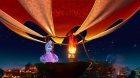
For the opening, the production shot foreground elements and Double Negative was required to lay in this "shock and awe" behind it. For the establishing shot, the camera move was later extended, so a CG environment replaced everything in the shot, though this also brought the advantage of making it easier to flood the foreground with interactive lighting on the CG buildings.
"We put lots of tracer into the sky and flashes and extended the environment around to give lots of lighting onto CG trees placed around [the general's] house," explained Charlie Noble, Dneg's visual effects supervisor. "And at the end of the scene we rise up on a big crane move to reveal the iconic images of the 'shock and awe' bombing. And for those we referred very closely to the images we could glean from all the journalists who were holed up at the Palestine Hotel just over the river from the Green Zone -- the images that we all remember from the time. That gave us really good reference to how big the bombing was and the scale of the plumes of smoke rising up from the government buildings in the Green Zone.
Meanwhile, the interior of the Republican Palace was covered quite extensively. "We built the portico area and used the façade in Spain that kind of represented the footprint, just so it would give us clues what the lighting might be like in the strong sunshine," Chiang continues. "And then we literally built the whole environment down to palm trees and vehicles and the whole gamut of military arsenal. And we really used them in aesthetic ways and, in working with Chris Rouse, the editor, we figured out themes and what shots would be most effective to back up Paul's narrative."
While the Dneg team worked on previs for some of the big establishing shots, it was more feasible to take all the CG models with them on set where they were fed into a new realtime virtual overlay system provided by Stein Gausterade. Thus, at any given location they would align the relevant CG building to the set and then Greengrass and the camera team could pan/tilt the virtual camera around the set to see the extent of the intended additions.
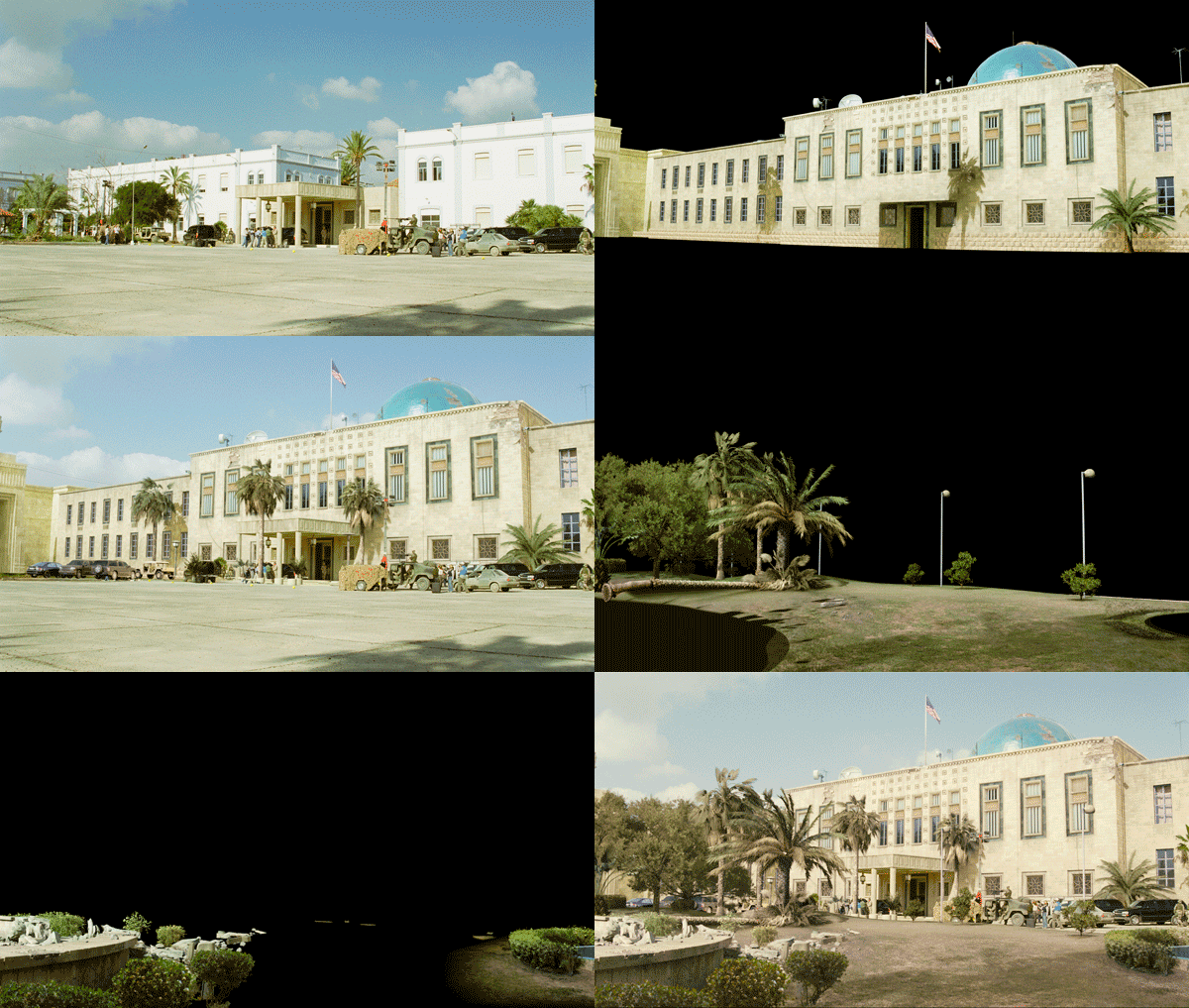
"Although Paul understands the technical to a fair degree, he pushes you and does it his way and you have to have the tools in place to allow him to explore," adds Chiang, who is currently working on Andrew Stanton's first live-action feature, John Carter of Mars, with Dneg. "So the virtual overlay system allowed the operators could get a sense of what the true volume would be in the environment and then make more informed decisions about how they would compose shots," Chiang suggests. "For example, there's a tilt down from the statue onto the Republican Palace and pans around the airport to know exactly where the terminal building was."
According to Noble, practical framing/eyeline guides were also used. One example was for a shot of Damon's Humvee driving down the Victory parade underneath the iconic crossed swords, for which they employed a crane's arm to stand-in for one side of the swords as an eyeline guide for the cast and a framing guide for the cameras.
Matchmoving was essential, of course, to Greengrass' frenetic style, so Dneg matchmovers were on set, recording all the camera info. In addition, they developed a device that would record any zoom info, which was used about 90% of the time. "We attached zoom-encoded wheels to the cameras (that recorded the focal lengths for each shot) and then that data was sent back down the line to a laptop," explains Noble. "And then to help us out, the grips (known as Dragon Grips) offered to carry the laptops in their backpacks, making life a lot easier. This zoom encoder information played a crucial role allowing the matchmovers to snap the survey scene to the photography, giving them a head start, though it still presented a major job and some shots took several days to matchmove. The roto team also played a huge role as greenscreens were hardly used and most of the shots had to be rotoed extensively."
Many of the vehicles had to be replaced in CG, including most of the helicopters. In a sequence requiring three Black Hawks to land, it was filmed using Huey's, chosen because they had a similar opening to Black Hawks for the actors to get in and out of. The Hueys were later replaced with CG Black Hawks into the real atmosphere, behind the dust that had been kicked up. Unable to access the blue prints of Black Hawks, Dneg tracked down rough dimensions from the internet. The Black Hawks were modeled as they are in real life along with essential 4K textures painted from scratch. In addition lot of roto was required, keying off of the atmosphere, with additional vfx and lighting work.

For all the CG trees they used Houdini L systems, which provided a very useful layout tool. The L system trees were baked out as series of rib-archives with varying levels of dynamics to simulate gentle breeze and varying atmospheric conditions so that the animators and the layout artists could pick pre-animated trees and plop them into their Maya scenes and then using simple bounding boxes for placement. And at render-time, the curves became trunks, fronds and leaves using custom in house shaders, which created displaced surfaces from the curves.
All the smoke and atmospherics in the background were done using Maya fluids and Dneg's own in-house fluid renderer, squirt.
Another sequence takes place at the poolside of the Republican Palace, inside the Green Zone. These were filmed on location in Morocco. A broad brush matte-line runs around the pool, made up of a set build wall on one side, a set dressed changing block on another and a hedge on the other two, beyond which the team extended with a CG Republican Palace and CG trees, along with some sizable CG dressing to the foreground as well. The Moroccan pool had its deep end at the opposite end to the real one in Baghdad, which had a knock-on effect of having the diving board at the wrong end. However, when the sequence was cut together, no one was actually using it, so it was decided to move it to the other end by painting it out of the few shots it was in and adding a CG version at the other end. A CG fountain was added to the pool that was impractical to have for real and various bits of CG shrubbery to match as closely as possible to the real thing.
The set extension work was pretty atypical, according to Noble. "You expect to have everything in the foreground for the photography and your extensions starting from the [mid-level] background. But here they placed the photography in the middle of a 3D environment, which was very challenging."
Bill Desowitz is senior editor of AWN & VFXWorld.

Bill Desowitz, former editor of VFXWorld, is currently the Crafts Editor of IndieWire.