
Fred Patten reviews the latest anime releases including new Robotech releases, Spring and Chaos: The Life and Times of Kenji Miyazawa, and the OAV and TV series of Vampire Princess Miyu.
Around 1995, Japanese animation (anime) began pouring into North America, Europe and across the globe in video form. Most of these titles were unknown outside of Japan and never covered by animation journals. Whether a title is highly popular or very obscure, a high-quality theatrical feature or a cheap and unimaginative direct-to-video release, they all look the same on a store shelf. Therefore, Animation World Magazine will regularly review several new releases (including re-releases not previously covered) that have merit and about which our readers should know.
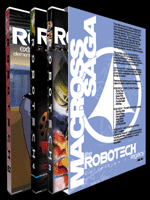
Robotech. The Macross Saga: V.1, First Contact. V.2, Transformation. V.3, Homecoming. V.4, Battlefront. V.5, War and Peace. V.6, Final Conflict. The Robotech Masters: V.7, A New Threat. V.8, Revelations. V.9, Counter Attack. V.10, The Final Solution. The New Generation: V.11, The Next Wave. V.12, Counter Strike. V.13, Genesis. V.14, Hollow Victory.
TV series (85 episodes), 1982-1985. American Producer: Carl Macek; Director: Robert Barron. Japanese Directors: (Macross) Noboru Ishiguro; (Robotech Masters) Yasuo Hasegawa; (New Generation) Katsuhisa Yamada. Price & format: DVD, English language, V.1 - 13, 6 episodes/150 minutes; V.14, 7 episodes/175 minutes; $14.98 each. Distributor: A. D. Vision Films.
The American Robotech and its Japanese Macross component are both monumentally popular and influential. Harmony Gold, an American global TV distributor, wanted to sell Tatsunoko Production Co.'s animated space-adventure TV serial Macross to American TV. But Macross was only 36 episodes and the syndicated TV market of the early 1980s required at least 65 episodes. Producer Carl Macek's solution was to buy two more space-adventure serials from Tatsunoko Pro, similar in basic plot and art design, and rewrite them into a single 85-episode saga spanning three generations. Robotech, debuting on American TV in March 1985, was designed for the teen Star Trek market. It was the first Americanized Japanese TV cartoon series to court the new anime fan cult openly instead of downplaying its foreign origins. Robotech was directly responsible for a sharp increase in anime fandom (an authorized Robotech convention in October 1986 drew 4,000 fans). At the same time, many TV stations treated Robotech like a typical juvenile TV cartoon, censoring scenes that they considered unsuitable for young children or disregarding the episode order, which destroyed story continuity. This influenced the anime fan perception that the American movie-TV industry did not understand anime, which led directly to the new fan-created anime specialty market in the late 1980s. Robotech has continued in popularity through TV reruns, licensed sci-fi novels and comic books to the present. Robotech II: The Sentinels, a planned 65-episode sequel written by Carl Macek and animated by Tatsunoko Pro, was aborted early due to business problems, but the animation that had been finished was turned into a video feature in August 1988; one of America's first animated direct-to-video movie releases.
Robotech
's most popular segment was the introductory The Macross Saga (in Japan Super-Dimensional Fortress: Macross, 36 episodes, October 3, 1982 - June 26, 1983). It features believable teen emotional entanglements as young combat pilots and officers on the space battleship Macross and adjacent civilians are thrown into constant contact as they battle the giant Zentraedi warriors attacking Earth. A major fan-favorite character is killed in action; there is an interracial romance; the main protagonist, fighter pilot Rick Hunter (Hikaru Ichijo), is embarrassed and confused to realize that he cannot decide, which of two girls he loves. (In Japan there were sequels to the Macross series alone, two of which, Macross II and Macross Plus, have been released in America.) The other two segments, The Robotech Masters (24 episodes; in Japan Super-Dimensional Cavalry: Southern Cross) and The New Generation (25 episodes; Genesis Climber: Mospeada), were less popular. They were actually failures in Japan, originally planned for 36 episodes but condensed and concluded early due to poor ratings.
Robotech
has previously been released on video in both partial and complete versions, simplified for children or uncut for anime fans. A.D. Vision's new DVD release is complete and uncut, but in English only since the American 85-episode story required such an extensive editing of the three separate series that the original Japanese dialogue tracks no longer match. Also, the individual Robotech DVDs do not include any extras. Those come with a special three-DVD boxed-set edition, The Robotech Legacy, seven sets at $44.98 each. Each Legacy contains two regular DVDs, plus an exclusive "Elements of Robotechnology" DVD with 2 hours or more of extras such as production sketches, character model sheets, a gallery of Robotech comic book covers, the complete 80-minute Robotech II: The Sentinels feature with a commentary by Carl Macek, creator interviews, and samplers of scenes from foreign releases in a wide variety of languages.
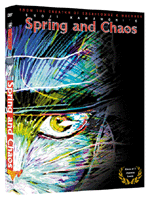
Spring and Chaos: The Life and Times of Kenji Miyazawa.
TV movie, 1996. Director: Shoji Kawamori. 57 minutes. Price & format: DVD $29.99 audio English & Japanese; subtitles Chinese, English, French, German, Korean, Spanish. Distributor: Tokyopop Anime.
Kenji Miyazawa (1896-1933) is today one of Japan's most revered authors, though he was practically unknown in his lifetime. Popular director Kawamori's tribute to him has the emotional impact of Frédéric Back's 1987 adaptation of The Man Who Planted Trees; of introducing the viewer to a man who, although generally unknown, left the world a better place for his contributions to it. "Misunderstood genius" is a simplistic summary, though if Kawamori's portrait is accurate, one can also sympathize with Miyazawa's exasperated father and associates; he was too impractical to survive in a materialistic world. The film covers Miyazawa's life during roughly his graduation as a geologist, his failure to sell his allegorical poems and fables to the commercial literary market, and his career as a teacher at a rural agricultural high school, where his rhapsodic lectures about the indivisibility of agronomy, geology, astronomy, paleontology, and all life and matter (a synthesis of Buddhist philosophy and news of scientific discoveries about atomic and molecular nature), amused his students but gave him a reputation as a fool or lunatic. Miyazawa is also shown as being deeply influenced by the slow decline and death of a beloved younger sister; alienation from an equally idealistic best friend who makes a "practical" decision to fit into Japan's growing militaristic society; and his rejection by reactionary peasants to whom he attempts to introduce modern farming practices. Kawamori presents this life story in a non-linear manner faithful to Miyazawa's constant shifting between reality and illusion: showing the characters as anthropomorphized cats (one of Miyazawa's most popular fables is The Cat Office); constant time-shifting back and forth between major events in his life; switching between art styles and animation techniques from traditional cel animation to "raw" CGI to chalk drawing (very like The Man Who Planted Trees) and others. There are brief glimpses of images in Miyazawa's imagination that Japanese viewers will recognize as characters from his best-known works like Night on the Galactic Railroad (the inspiration for Leiji Matsumoto's popular sci-fi manga and anime series, Galaxy Express 999), The Earth God and the Fox and The Twin Stars. These will be meaningless to most Americans, though Spring and Chaos is inspirational enough to encourage one to seek them out. (The Japanese title is Ihatov Genso - Kenji no Haru (Ihatov Illusions - Kenji's Springtime from Miyazawa's fantasy dreamland of Ihatov). This one-hour TV movie commissioned for the centennial of his birth, produced by Group TAC and broadcast December 14, 1996, won a Japan Culture and Art Foundation Award and the 23rd Cultural Broadcasting Foundation Award for Best TV Entertainment Program.
Vampire Princess Miyu. V.1, Unearthly Kyoto & A Banquet of Marionettes. V.2, Fragile Armor & Frozen Time.
OAV series (4 episodes), 1988-1989. Director: Toshihiro Hirano. 50 minutes each. Price & format: DVD bilingual $24.95 each. Distributor: AnimEigo.
Visual allusions to Anne Rice's Interview With the Vampire are to be expected, but look for the scene in which two students in a school library discuss the advantage to vampirism of never growing older; a vampire will "live" forever. The camera flashes briefly on a book; the title is not shown but the author is Michael Ende. Ende is, of course, author of The Neverending Story. Vampire Princess Miyu was one of the first OAV productions from the Anime International Company studio; four half-hour episodes released between July 1988 and April 1989 (and one of the earliest anime releases in America, on both subtitled and dubbed videos by AnimEigo in May and June 1992). It was somewhat of a husband-wife collaboration between director Hirano and character designer & animation director Narumi Kakinouchi, who also wrote and drew the original Vampire Princess Miyu manga. (Kakinouchi specializes in vampire cartoon-art novels with heavy romantic/psychosexual overtones, which are often reviewed with terms like "elegant" and "vampire chic".) The pair avoided the problems of a low-budget production with an intriguing story that does not need animation-intensive scenes: intelligent conversations, emotional conflicts, moral dilemmas, a slow buildup of terror in shadowy, motionless settings, and clever references to the vampire classics. (Miyu, the young vampire girl, is quietly amused by the whole Dracula stereotype.)
Himiko Se, a psychic detective/spiritualist, learns that Earth is surrounded by a supernatural dimension called the Dark. The age-old barrier separating Earth from the Dark is weakening and hungry ghosts called Shinma are breaking through to prey on humanity. Miyu, a centuries-old vampire permanently frozen in mid-adolescence, has been assigned to enforce the barrier by capturing the Shinma and returning them to the Dark. This has the side-effect (incidental to Miyu; all-important to Himiko) of saving humans from being devoured by the Shinma. But Miyu herself needs human blood; although, as she points out, she does not take so much that her victims die. Himiko is tormented over whether she should aid Miyu as the lesser of two evils, or try to slay them all. Her dilemma is complicated by the psychological problems of the Shinmas' victims, which cause them to embrace their predators willingly. Aina is a sick young girl whose life is saved by massive blood transfusions, giving her the delusion that she has become a vampire. Kei Yuzuki is a "golden boy" high school senior, handsome and rich, who is bewitched by a Shinma succubus. Or is he stalking her, desperate to escape his future life which has been planned for him in rigid detail by his domineering family? Miyu herself, for all her condescension towards "mere" humans and their weaknesses, seems more envious than contemptuous of the mortal girls who will mature beyond adolescence into full womanhood.

Vampire Princess Miyu. V.1, Initiation. V.2, Haunting.
V.3 - 6 (titles not yet determined). TV series (25 episodes), 1997-1998. Director: Toshiki Hirano. Price & format: V.1, 3 episodes/75 minutes; V.2 - 4, 4 episodes/100 minutes each; V.5 - 6, 5 episodes/125 minutes each. Video dubbed $19.99; DVD bilingual $29.99 each. Distributor: TOKYOPOP Anime.
Almost ten years after its OAV incarnation, Vampire Princess Miyu was re-adapted into a 25 episode TV version. Director Hirano and music composer Kenji Kawai ably performed their same roles. Kakinouchi advised on story and art, though actual character designs are by Megumi Kadonosono. American rights to the TV series have been sold to a different anime specialty company, creating confusion as to what extent differences between spellings and names are due to different American translators and to what extent they represent actual changes. The distinction between "Larva" and "Lava" (the name of Miyu's silent pretty-boy Shinma assistant; resonances to the English word "lover" may be inferred) and "the Dark" and "the darkness" are presumably translators' decisions. The distinction between director Hirano's first name is actual; American fans learn to get used to Japanese filmmakers adopting and dropping nicknames and pseudonyms. To increase the confusion, AnimEigo lists the credits in Oriental name order (e.g. Kakinouchi Narumi), while TOKYOPOP lists them in Occidental name order (Narumi Kakinouchi). And both series are titled simply Vampire Princess Miyu.
The TV version is specifically aimed at young adolescents. In the OAV, one episode is set in a high school where Miyu impersonates a student while she tracks down the Shinma on the campus. The whole TV series is set around a middle school which she uses as a home base as she searches for Shinma throughout the surrounding large city, while entering the school as Miyu Yamano, a 13-year-old transfer student. Chisato Inoue, a bubbly young teen, invites Miyu to join her girls' clique. Miyu accepts to improve her disguise as an ordinary student, but is soon drawn into genuine friendship with Chisato, Yukari and Hisae. Larva is transformed from a probable offstage older lover into a helpful big brother, and Miyu gains a cutely grotesque Shinma talking bunny-rabbit pet (with blatant plush toy potential). The OAV was deliberately vague as to Miyu's personal feelings about humans. The TV series turns this into a definite conflict by splitting Miyu's personality and giving the callous half to Reiha, a second Shinma hunter who appears in Episode #4 to assist her. Reiha is only concerned with finding Shinma and sees nothing wrong with using humans as disposable bait. This crystallizes Miyu's determination to put the safety of humans above their job of returning Shinma to the darkness, making her a clear heroine and protector of her school chums from Reiha as well as the Shinma. Miyu's personal need as a vampire for blood is essentially forgotten. The TV series has more action scenes than the OAV (to appeal to teen viewers), which makes the limited animation (again by A.I.C., in cooperation with Group TAC) more obvious. Despite being tailored for young adults, the Vampire Princess Miyu TV series ended up in a Tuesday 1:15 a.m. time-slot, October 7, 1997 through March 31, 1998, where few saw it. This was a pity, because the TV series is quite a good Young Adult fantasy thriller; certainly more intelligent than most of the anime adolescent T&A fantasies about air-headed super-endowed sex toys or lust-demons out to ravish all the coeds. Both the OAV and the TV versions have their merits, and neither is a pale imitation of the other.
Fred Patten has written on anime for fan and professional magazines since the late 1970s.