
Karl F. Cohen continues his investigation into animation being used as a tool in the Cold War with this look at a selection of films produced in the 1950s.
Part Two Cartoon Shorts; A Preliminary Report on Militant Liberty Films

Frances Stoner Saunders discusses the CIA's Militant Liberty policy in her book The Cultural Cold War.
In Frances Saunders book The Cultural Cold War: The CIA and the World of Arts and Letters (Who Paid the Piper? in England), she mentions a policy developed in the 1950s called Militant Liberty. The phrase was the name of a top-secret campaign by the CIA, Pentagon and other agencies that encouraged studios to insert the theme of freedom into our movies in the mid-50s. It also can be used to describe an informal trend or movement to include pro-American content into films. In the 1940s it is seen in a series of anti-Nazi and then anti-Communist films.
Saunders covers some of the Militant Liberty themes Carleton Alsop wrote about in memos to the CIA when he was working undercover at Paramount. In Arrowhead (1953), he saw serious potential problems that the Commies could use to their advantage. The film about the Apaches was tinkered with so scenes of the Indian tribe being shipped against their wishes to a reservation in Florida were removed or their impact (was) significantly diluted. After the film ended its run in the U.S., dialogue was re-dubbed so that the international release could be presented on a commercial and patriotic basis.
Images showing heavy drinking in our films were eliminated when they were not essential to the script. Showing Tobacco Road poverty (especially in our black population), corporate knavery, being irreverent toward organized religion and showing outrageous crimes were other themes to avoid if possible. Alsop wanted Hollywood to avoid showing negative stereotypes and to include characterizations which represented a healthy America.
The CIA called the Militant Liberty image of a sanitized America the Hollywood Formula. While Saunders doesnt discuss how it affected short films and cartoons there are differences in the content of cartoons from the 1950s from those that were made before WWII. There is a reduction of racist stereotypes, drunken scenes, showing people living in poverty, etc. Which elements if any were reduced or cut consciously by Militant Liberty advisors is impossible to know at this point. For example while black stereotypes were eliminated in Warner Bros. cartoons by 1950, there are several Bugs Bunny cartoons from the 50s showing hillbillies and criminals living in shacks. At Paramounts Famous Studios shacks were omitted from their 1950s productions, but Casper the Friendly Ghost lived in a rundown ruined house and the last black stereotype appears in a cartoon from Famous in 1958. (Alsop worked for Paramount in Hollywood and Famous was in New York so it appears his influence wasnt as strong there.)
While the influence of patriotic watchdogs to remove negative images in cartoons is impossible to prove, their influence is obvious in several cartoons that promote freedom and the American way of life. The films to be discussed from Warner Bros., Sutherland, Disney and other studios are clearly propaganda and none would have been made if it were not for outside money and advice. Most clearly state in the opening or end credits who sponsored the film, but what isnt said is whom the sponsors really were and why they felt there was a need to present these messages to the public. We might also wonder from where their money came. In 1967 the New York Times revealed that the CIA was using private and corporate philanthropic foundations as conduits to fund some seemingly innocent educational projects. It isnt known if government funding was used to make any of these films, but Disneys Our Friend the Atom, 1957, was made with the assistance of the Navy and Duck and Cover, 1951, was sponsored by the U.S. Federal Civil Defense Administration.
The Sloan Foundation, Harding College and John Sutherland Productions
Alfred P. Sloan (1875-1966) was the CEO of General Motors from 1923 to 1946. He is considered the father of the modern corporation. Today his foundation is a major supporter of PBS radio and TV, medical research projects and other impressive projects. The foundation has ties with many major corporations and institutions. They were not mentioned in the 1967 scandal over the CIA using foundations as conduits.
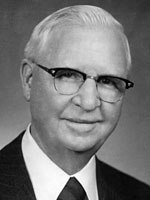
George Stewart Benson, president of Harding University, was tapped by entrepreneur Alfred P. Sloan to make propaganda films. Courtesy of Harding University.
A story that sounds too simplistic to be accurate is Sloan heard George Stewart Benson, president of Harding College in Searcy, Arkansas, deliver a fundamentalist anti-labor diatribe and was so moved that he decided that day to underwrite Harding Colleges plans to produce educational anti-Communist, pro-free enterprise system films. In any case the Sloan Foundation did give Harding a lot of money to produce propaganda films (reports vary from $300,000 to $597,870). There were nine animated films made for Harding using money donated by Sloan according to Rick Prelinger. He runs Ephemeral Film, a film library that had an enormous collection of unusual films paid for by corporations, educational institutions and our government. The collection was purchased by the Library of Congress in 2002.
I find it hard to believe that the just-retired head of General Motors would fund an expensive propaganda film in Technicolor and let a school in Arkansas with no track record as a film producer handle the project unless there was an unstated ulterior motive. Sloan isnt mentioned in the film credits, which is odd as most sponsors want some recognition. Did he want the school to be his front? Something about the project doesnt make sense.

Benson's deal with Sloan benefited Harding University financially. Courtesy of Harding University.
Since the first of the Harding films dates from 1948 and the CIA was created in July 1947 it is possible, but unlikely that one of the CIAs first activities was to fund propaganda cartoons. It is possible the films were made at the request of another federal agency, but most likely the money used was Sloans. He probably felt there was a need for strong anti-Communist propaganda films and using Harding would keep his name from being identified with the cause. It is common for foundations to give restrictive gifts that are designed for the money to be used for specific purposes.
Mike Barrier, author of the remarkably well-researched Hollywood Cartoons, interviewed John Sutherland in February 1990. Sutherland owned the Hollywood studio that produced the animated series for Harding. His interview confirms the above scenario and adds additional information. Sutherland told Barrier that Sloan sent a representative to Walt to approach him about making cartoons on economic themes and that Walt sent the representative to Sutherland. Sutherland told Barrier that Sloan gave a grant to Harding so they could commission him to make the films. Harding owns the rights to the films so any income from them went to the college. The school also owns the negatives to the films. Barrier was also told, So I got a million dollar contract.
Sutherland probably inflated the amount of the contract in his conversation. A typical Warner Bros. cartoon cost about $23,000 to make in the mid-50s and George Pal Puppetoons were costing under $50,000 at Paramount after WWII. Prelingers $597,870 is probably the most likely amount for the grant.
Eventually other conservative corporations contributed to Harding including General Electric, U.S. Steel and Olin Mathieson Chemical. By 1961 Hardings endowment from corporations was said to be $6 million.
Harding, founded in 1924, began as a small religious college, run by the Church of Christ. It is named after James Harding, a minister who was co-founder of the Nashville Bible School. The school was integrated in 1962, becoming the first college in the state to integrate. Today Harding University is a much larger institution offering a wide range of degree programs.
Bensons biography includes his being born in a log cabin in Oklahoma in 1898, going to a one-room school and eventually graduating from Harding in 1925 with a B.A. He and his bride spent the next 11 years as Church of Christ missionaries in China. In 1936, Harding College urged Benson to take over the presidency and for the next 29 years of his presidency Benson raised a great deal of money for the college. In 1936, he formed the National Education Program dedicated to teaching Americans the importance of faith in God, constitutional government and free enterprise (from Horatio Alger Association of Distinguished Americans). Benson retired in 1965. He was also chancellor of Oklahoma Christian University and presented a radio program Behind the News for many years. The Arkansas Archive of Public Communication has 543 tapes of his radio broadcasts on file (197585). He died in 1991.
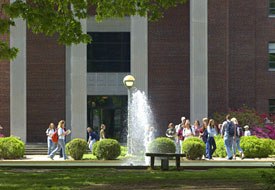
Arkansas' Harding University started as a small Christian college and is today a large institution. Courtesy of Harding University.
On the Internet, there are references to the John Birch society and other conservative groups showing films produced by Harding College. There are also references to people who question Bensons beliefs. A review of Arkansas Mischief by Jim McDonald in the Denver Post, 1998, describes the purpose of Hardings National Education Program as to spread warnings of Communist peril lurking in the civil rights movement and among the ranks of peace demonstrators. An unidentified writer for www.spiritone.com says the organizations sole purpose was to produce propaganda films supporting his fascist views and the Church of Christ opposes most modern doctrines including Darwins theory of evolution. While the information on the site includes oversimplifications and basic factual errors, it does indicate the controversy that exists about Benson.
Harding hired John Sutherland Productions in Los Angeles to produce their animated films. Sutherland (1910-2001) worked for Disney for several years (chiefly as a writer) before opening his own studio in 1945. His first productions included the animated Daffy Dillies series for United Artists and a series of animated one-minute theatrical ads for Chiquita Bananas. He experimented using puppets in at least one of his early Daffy Dillies, but he became known for his high-end cel animation. It appears that his first propaganda films were for Harding College. They were distributed to theaters and to schools, civic groups and corporations by Loews, a division of MGM. He received an Oscar nomination in 1968 for the documentary short A Way Out of the Wilderness. His biography published in trade annuals says he was the creator of Thumper in Bambi. He was given screen credit in that film for being one of two actors doing the voice of Bambi.
Bill Scott on Working at Sutherland
In the mid-1950s Sutherland hired Bill Scott as a writer. Scott told Paul Etchevery in an unpublished interview taped November 2, 1981 that working at the studio, was pretty fascinating, as a matter of fact. I had never worked on that kind of picture before. They were propaganda and informational pictures in large part, which meant that you took a problem of communication that somebody wanted to handle. They would give you points a, b, c, d and e that they wanted the picture to be about or convey. Then the writer would come up with the entire concept of how to do it and what kind of characters and how best to use animation, and develop the entire picture from its concept to its final production. It was a very useful training ground for me although the material wasnt what I would normally have picked to work on.
Scott found the work great training for the tight deadlines he had later on as co-producer and head writer at Jay Wards studio (Rocky and Bullwinkle). He said, I learned a great deal but, I was not particularly happy at Sutherland studio. The material I was doing was not anything I really believed in, but there was always a great set of challenges. It was always a satisfaction to be able to solve problems, which is largely what writing is. It is like doing puzzles. He also says he was well paid and, We traveled first cabin all the way. He described the quality of the studios work as really good stuff, but left after four years: I couldnt stand it anymore.
The Sutherland Productions
The following are examples of the kinds of animated propaganda shorts produced by Sutherland for Harding and other clients in the late 1940s and 50s. The films for Harding began with a card that reads, This is one of a series of films produced by the Extension Department of Harding College to create a deeper understanding of what made America the finest place in the world to live. After screening several of the studios propaganda films, Chris Robinson, artistic director of the Ottawa International Animation Film Festival, wrote, The major theme of the series is the reconciliation of labor and management, along with the need to reinvest profits into research and developmentthe conclusions of each film delivers the same message: as consumption is both a means and an end in defining American freedom. (Essay titled Selling America: Post-War Propaganda Cartoons, in the 1999 Ottawa International Student Animation Festival Reader.)
Giving the viewer lots of facts is part of each film. They stress the freedoms given to us by our Constitution and Bill of Rights from religious freedom and free speech to the right to own your own business. We learn the USA occupies only 7% of the planet, but we own 70% of the cars, 92% of the earths bathtubs and 50% of the radios. A film sponsored by the New York Stock Exchange explains each step a corporation has to take before they will list that stock. After showing us how great the system is, they issue a warning that occasionally they list a lemon, so read carefully before you invest.
All the Sutherland films were released in Technicolor. Most are eight to ten minutes long. Some of the films have dates in the title sequences, but others do not. It was common to leave out dates in industrial films (a.k.a. sponsored films) so people wouldnt know how old the film was. These were films shown in schools and to other groups year after year. Since older animation doesnt always look dated, hopefully these films could stay in distribution for many years. It is difficult to date some of them accurately. Many of them can be seen at no cost on the Internet at Ephemeral Films Websites.
A Description of Several Sutherland Productions
-
In Make Mine Freedom for Harding College (Sloan Foundation), 1948: Dr. Utopia is selling bottles of ISM. The substance is said to work miracles, but it is really an evil system that could lead the American worker down the road to slavery. Dr. Utopia will take away our constitutional rights. Before people swallow the salesmans hogwash, John Q. Public butts in and reminds the crowd about what made this country great capitalism. Then we see what life would be like under Dr. Utopias dictatorship (Communism at its worse).
- Going Places for Harding College (Sloan Foundation), 1948, is a Cold War cartoon defending the profit motive against anti-capitalist critics. The film stars a young soap maker whose business grows into a large business thanks to a good product, loans and his selling stock in the company.
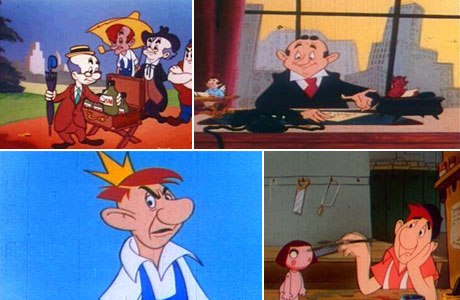
Shots from Sutherland Productions' films (clockwise from top left): Make Mine Freedom, Going Places, Why Play Leap Frog? and Meet King Joe.
-
Why Play Leap Frog?, for Harding College (Sloan Foundation), 1949, is about the correlation between rising labor cost and higher prices. Labor can beat inflation with more efficient tools and factories that produce more and better things in less time. The worker in the film works at the Dilly Doll factory.
-
Meet King Joe, for Harding College (Sloan Foundation), 1950, is a Cold War cartoon aimed at American workers with the objective of convincing them of their good fortune. We are told the American way of life means we can consume more new items because our bosses are reinvesting some of their profits in new tools which somehow means a worker can produce more in less time so his wages can go up while the item can sell for less. And that is why we are the industrial capitol of the world.
-
Albert in Blunderland, 1950, shows us a planned economy run by ants. There are no labor unions or freedom of expression. The films hero, a car mechanic, wakes from his nightmare just as he is about to be shot for expressing his dislike of the ant colony system.
-
The Littlest Giant, date unknown, sponsored by the National Consumer Finance Association, is a lesson about all the things you can do with bank loans. Go into debt so we can maintain Americas supremacy as the worlds most powerful consumer nation.
- Inside Cackle Corners, 1951, is a film that takes place in a town run by chickens dressed like humans. There is competition between an old fashion store and a modern one that can sell a better item for the same price. The conservative storeowner gets smart and goes to a bank for a loan so he can expand his business. Of course he gives his employees raises too, just like bosses in the real world. It ends showing us the automatic kitchen of the future with robotic appliances making life easy for us. Credits for art direction go to Gerald Nevis and Edger Starr, music by Darrell Calker and animation by Arnold Gillespie, Phil Monroe, Armin Shaffer and Bob Bemiller.
-
In What Makes Us Tick, 1952, John Q. Public lives in a modern home with his typical American family. He learns how the stock market works including the steps taken to get a stock listed. Made for the New York Stock Exchange, the associate producer was George Gordon, Carl Urbano was the animation director and the art directors were Gerald Nevius and Edger Starr. The music was by Eugene Poddany and the animation was by Arnold Gillespie, Emery Hawkins and Bill Higgens.
- A is for Atom, 1953, sponsored by the General Electric Co., explains how the atom works and what makes uranium so special (it can be used for the good of mankind). There are great images of a giant with arms folded representing atomic power, but the long explanations of the mysteries of U-235 and U-238 are somewhat dull.
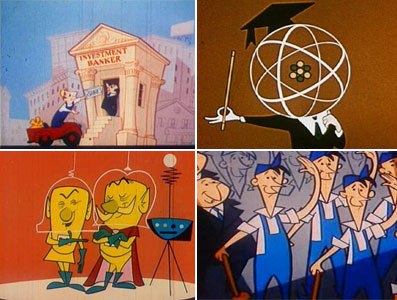
More moments from Sutherland Productions' animated propaganda shorts (clockwise from top left): What Makes Us Tick, A is for Atom, Destination Earth and Its Everybodys Business.
-
Destination Earth, 1956, is a thinly disguised anti-Communist film about life in a poorly run dictatorship on Mars. The great leader Ogg sends Colonel Cosmic to earth to find out if there is a better way to run his limo. Cosmic learns about how Americans use oil to power cars and to lubricate things to prevent friction. He steals a book from a public library about business competition and capitalism. By introducing the American way of life on Mars, we are led to believe Oggs days are numbered. Directed by Carl Urbano. Animated by George Cannata, Ken OBrien, Bill Higgins and Tom Von Neida. Written by Bill Scott, Michael Amestoy and George Gordon. Production design by Tom Orb and Vic Habough. Sponsored by the American Petroleum Institute.
- Its Everybodys Business, not dated, but probably about 1956, tells about the building blocks of freedom and it warns us about the destructive forces of war. The lessons learned from WWII (rationing, frozen wages, fixed prices, shortages, etc.) should help us to avoid evil forces in the future. In the film a hat maker learns about free enterprise. Maurice Noble, art director, created the films modern look. George Gordon was the associate producer, Carl Urbano was the animation director and the script was by Bill Scott and George Gordon. The animators were , Emery Hawkins and Abe Levitow. The narration was by Macdonald Carey and the music was by Lex Baxter and Eugene Poddany.
Warner Bros.
In the mid-1950s the Sloan Foundation funded three theatrical cartoons made by Warner Bros. that have heavy-handed economic messages within them. Heir Conditioned (Freleng, 1955) has Elmer Fudd trying to convince Sylvester to invest his inheritance rather than spend it. In By Word of Mouse (Freleng), we are taught the benefits of mass production and consumption, and Yankee Dood It (Freleng, 1956) presents capitalist theory on how to run a profitable factory. It is somewhat amusing to see Elmer Fudd waxing poetically about mass pwoduction and pwofits.
Jerry Beck, co-author of Looney Tunes and Merrie Melodies, 1989, says the Sloan Foundation paid the studio $25,000 to produce each cartoon and each was produced with a $23,000 budget resulting in a profit before the films were even shown to the public. The films are still shown on TV by the Cartoon Network. Fans rarely say anything nice about them and all three made it onto an Internet list of politically incorrect stereotypes that seem to offend just about everyone. They are listed under a special category, capitalist propaganda (Sloan Foundation cartoons), at www.nc.rr.com/tuco/looney.lists/politically.
While there is no proof any animated short was produced under our governments Militant Liberty program, the three from Warner Bros. are possible candidates. They were made at the right time, their content was the type of material the Militant Liberty people wanted and cartoons from Warner Bros. were seen in many countries. In an e-mail from Frances Saunders, she said, The Sloan Foundation was, as I'm sure you know, full of cold warriors (including Lucius Clay) and, if memory serves, it was used as a conduit by the CIA. But I don't think I have anything in my files to help you. It would be a mistake to jump to conclusions about the circumstances under which these films were made.
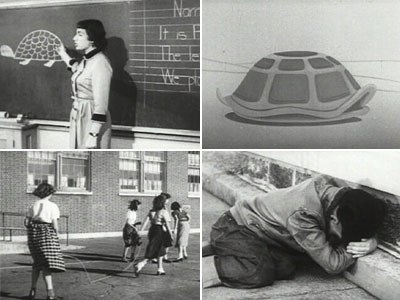
Archer Productions introduced Bert the Turtle to teach children how to survive an atomic blast in Duck and Cover.
Animation from Disney and Other Producers
-
Duck and Cover, 1951, Archer Productions, nine minutes, a how to survive an atomic blast, a film for kids starring Bert the Turtle, an animated star in a live-action film. Sponsored by the U.S. Federal Civil Defense Administration. Clips from the title song that show Bert demonstrating how to save your life when the bomb explodes were a highlight of Atomic Café, a feature length documentary.
- Our Friend the Atom, released January 23, 1957, Disney, Technicolor, was made to help promote the governments Atoms for Peace program, and was made with the help of the U.S. Navy and General Dynamics.
Live-Action Propaganda Films Made for Harding College