
Rick Baumgartner talks with ESC Entertainment about its transition from The Matrix trilogy to such upcoming visual effects projects as Catwoman.

Having finished the vfx for the Matrix trilogy, ESC looks to the future. Courtesy of ESC Entertainment. All Matrix Revolutions images © 2003 Warner Bros. Ent. U.S., Canada, Bahamas & Bermuda. © 2003 Village Roadshow Films (BVI) Ltd all other territories (all rights reserved used by permission), unless otherwise noted.
In 2001, a small group of digital artists, engineers and managers teamed with a pair of visionary directors to create a new kind of visual effects organization in Alameda, California. One blockbuster franchise later, armed with more than 800 jaw-dropping shots, ESC Entertainment prepares to take on the big guns of the visual effects industry as Warner Bros. non-exclusive subsidiary.
Too often, profiles of successful companies smack of the old Steve Martin bit on how to become a millionaire (First, says Martin, get a million dollars). One might take a similar view of ESC. Well, sure, you say, if I had Joel Silver running interference with the suits, the Wachowski brothers dreaming up fiendishly complex visual worlds, and checks with lots of zeroes to spend on talent and technology I could have come up with an organization to create awesome effects.
If you look at what really happened, you might think differently.
Improving on the groundbreaking Bullet Time effects work on The Matrix in two ambitious sequels would have given pause to even an A-list effects studio, much less one existing solely in the minds of its founders. Through a variety of events chronicled extensively in the trade and popular media, ESC found itself in the challenging position of clearing the technical and creative bar raised in the first movie. But this time with no facility, equipment or staff.
The rest is now history. ESC created some of the most memorable action sequences in recent movie memory, including the Burly Brawl, Freeway Chase and Trinity Falls in Matrix Reloaded and The Siege and numerous Neo/Smith slugfests in Matrix Revolutions.

replace_caption_esc02_TomDavila.jpg
But the most remarkable thing about the ESC story and its legacy to future teams of visual effects practitioners is that ESC evolved as an organization while it was researching and developing new technologies, building staff, facilities and production pipelines and delivering shots. Seven team members started ESC: Kim Libreri, Janet Yale, Tom Settle, Dan Piponi, George Borshukov and Paul Ryan.
Organizations reflect the life and times of their founders ESC is no exception. In many ways the immense scope of the Wachowskis world demanded an organization dedicated to it. And, yes, luck (along with box office clout) had a lot to do with ESCs founding, growth and creative and technical success. If the first film had tanked, ESC might still be a twinkle in the eye of its founding team (and this article certainly would never have been written).
But sometimes things just come together in a perfect storm of drive, talent, technology and audience appetite. ESC Entertainment is the result of this remarkable confluence of events. Indeed, one could argue that ESC as a company, along with the films themselves, is an artifact of the creative vision of the Wachowski brothers.
ESCs basic business model is simple: providing cutting-edge visual effects for major studio releases at a reasonable profit. Though not strictly Warner Bros. in-house visual effects provider, the company nonetheless secured lead roles in the studios upcoming Catwoman and Constantine, and is a leading vfx contender for the Superman remake too. Plus, ESC has been actively soliciting work on such non-Warner Bros. projects as The Ladykillers, helmed by another famous pair of sibling filmmakers the Coen brothers.
ESC president Tom Davila and ESC visual effects supervisor Libreri reviewed some of the major lessons ESC learned from its Matrix experience and how it plans to respond to challenges of its post-Matrix future.
First, ESC learned that early and constant collaboration with directors is critical to the success of the project. As Libreri puts it Andy and Larry [Wachowski] knew exactly what they wanted. They werent afraid of upsetting the status quo even if that meant chucking traditional departmental boundaries. We had worked with them on the first movie. We wanted to make the best visual movie we could do. And the way we did that was having everybody work closely with visual effects. This close early contact especially in set construction, lighting, camera and stunts helped streamline production by making sure that effort and expense was spent only creating the parts of Matrix world audiences would see.
Second, ESC learned to focus on technologies to help directors realize their vision of photoreal environments and characters (especially virtual humans). Adds Libreri: ESCs not afraid to deploy hard core technologies in pursuit of realistic images. ESCs advances in large-scale motion capture, high-dynamic range imaging, facial animation, machine vision, image-based lighting and rendering and virtual cinematography are examples of this technical focus.
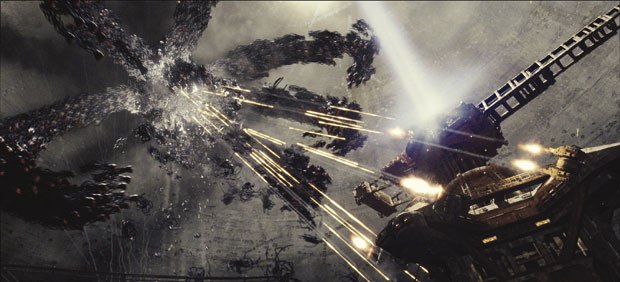
ESCs work on the trilogy set new vfx standards. Here the Sentinels retreat as the Zion crane tower attacks with gunfire in Matrix Revolutions. Courtesy of ESC Entertainment.
Third, ESC demonstrated that major film projects can be developed and delivered on value priced production equipment. ESCs pipeline, for example, contains industry basics such as Windows 2000, Dell hardware (more than 2,000 CPUs for render processors and workstations), Alias Maya (previs and animation), mental images mental ray (rendering) plus 70 terabytes of data storage and a high-speed network to tie it all together. We are one of the few visual effects facilities outside of some mom-and pop companies to be completely Windows-based, asserts Davila.
This combination of custom software and off-the-shelf hardware allowed ESC to scale up operations quickly and more cost-effectively than other options. It got hairy early on. Recalls Libreri, ESC opened its doors a couple of weeks before principal photography started. We had to deploy methods and technologies to capture images and information from set. We had a couple of workstations that we bought from Circuit City to do the previsualization for the Burly Brawl and build the asset database.

With each Matrix installment, ESC had to top itself. Above, the Sentinel descends upon the Swarm in Revolutions. Courtesy of ESC Entertainment.
Fourth, ESC re-confirmed the importance of attracting and retaining top-notch talent. At the height of the workload on the sequels ESC employed more than 300 artists and engineers; it now employs about 175. The companys location on a converted Navy base in the San Francisco Bay gives professionals an alternative to both giant ILM and boutique commercial shops.
Libreri and Davila realize that in order to attract the best talent, their playground must be cooler than its competitors. And while many visual effects practitioners long for the big score or the indefinitely long gig, people will move.
Everybody has the chance to contribute, says Libreri. Nothing is set in stone. During the avalanche of production training, new hires on the companys proprietary systems became a priority. Libreri credits the open professional atmosphere at ESC as being one of its greatest draws: The company is still small and informal enough for people to participate in more than one job or area of expertise.
Finally, and most importantly, the ESC team did great work they (along with several other facilities) created visuals to match the Wachowskis vision. To Libreri this is the most important legacy of ESCs Matrix experience as it hurtles into the future. Our job, he notes, is to give directors the tools they need to create things theyve never seen before.

ESCs work on this fight scene between Neo and Smith helped make it memorable to audiences.
Predicting the future of ESC, though, is a tough proposition. Only time will tell if ESC continues to thrive with or without Warner Bros., or if it will inevitably go the way of Boss, Cinesite, Warner Digital, Manex and other distinguished predecessors. There is no escaping the reality that ESC now finds itself competing with the likes of ILM, PDI and Imageworks, among others, who are used to working with multiple clients.
Controlling costs is always a factor. But ESC is mindful of how its relationships with creative teams, hard core imaging technology and talent retention are designed to deliver the best possible images at reasonable costs. According to Davila, The toughest thing is to deliver the effects you promised at the cost you promised. He suggests that ESCs remarkable ability to evolve so quickly during the Matrix experience is a testament to its artists, engineers and managers.
Which is why the most revealing part of the ESC story is that a dedicated and talented group of artists and engineers have already created a world-class visual effects company. The big effects studios do not have the market for visual effects innovation sewn up. There is still opportunity for upstarts and startups.
Visual effects producer Rick Baumgartner is working on the NBC show Las Vegas at Stargate Digital. He can be reached via his Website: www.vfxproducer.com.